invoice-extractor
Turns photos and PDFs of invoices into rows ready for the books: Claude reads them, accounting rules check every number, and what does not add up goes to a person.
Invoice and receipt reading in .NET 10 with Claude Haiku 5.5: deterministic validation after the model, a queue in PostgreSQL, human review beside the original, and export to Excel and CSV.
- Role:
- Design and development
- Year:
- 2026
- false auto-approvals in the evals
- 0/42
- planted errors sent to review, none approved
- 7/7
- accuracy on total, date, tax id and number, with the retry
- 100%
- model cost per document
- $0.00065
Demo
Screenshots
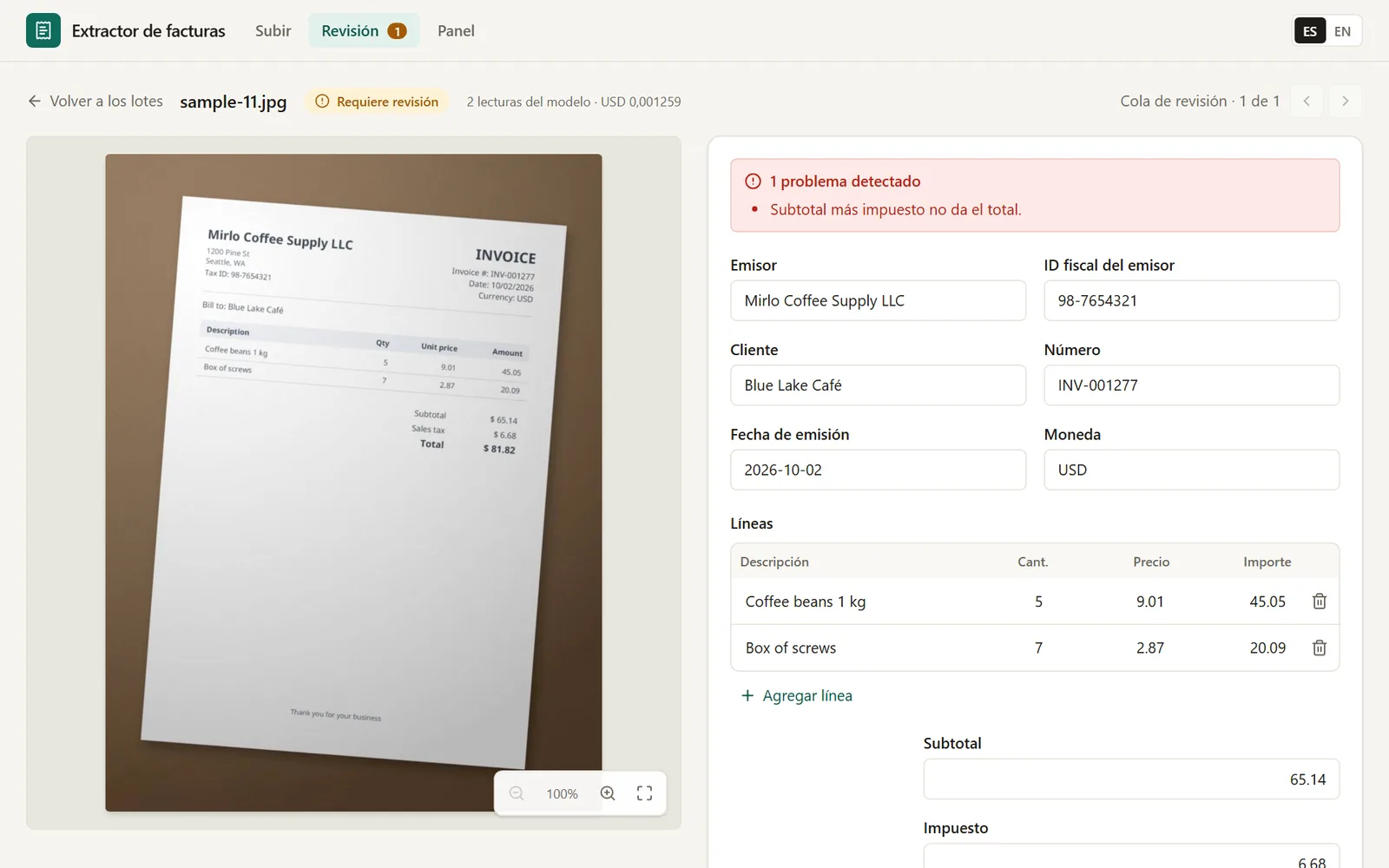
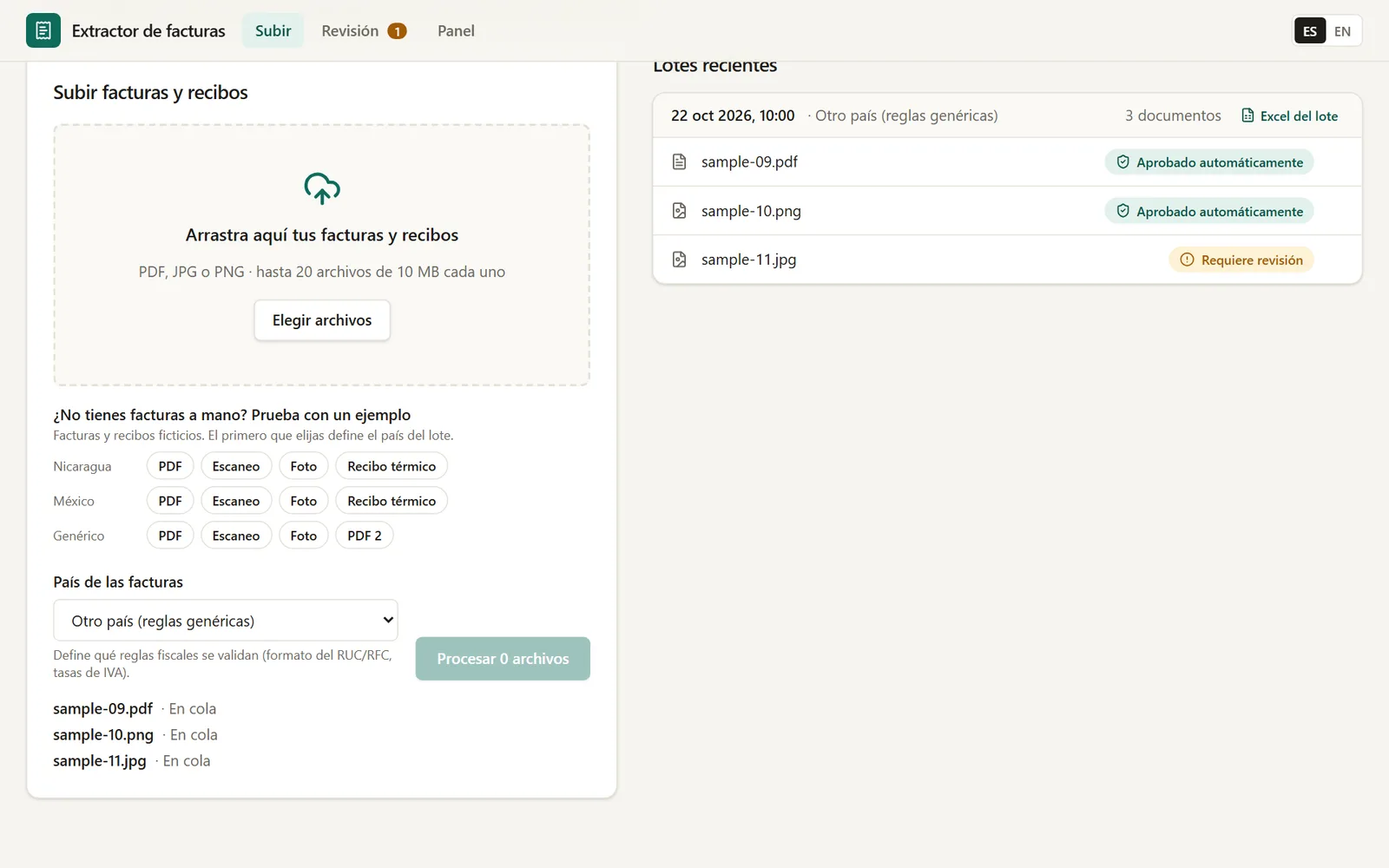
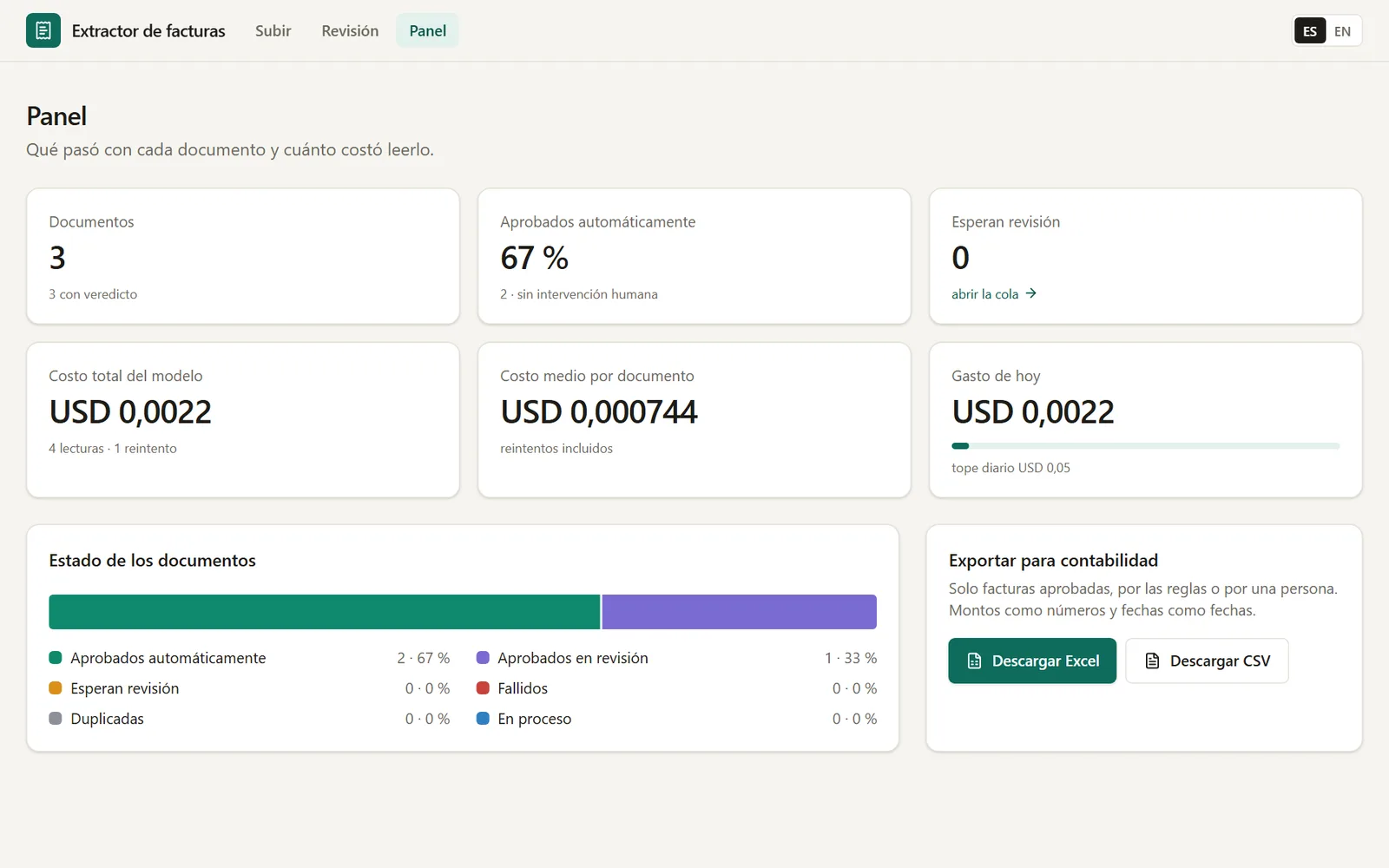
The problem
Many small businesses still type their invoices into the books by hand. A language model can read them, but it is sometimes confidently wrong, and a misread invoice in the books is worse than one left out. The goal was a reader you can trust: one that approves only what it can check, and sends the rest to a person with what they need to decide quickly.
Constraints
- Nothing is approved on the model's word alone: every reading is checked by rules
- Tilted photos, poor scans, thermal receipts and PDFs, in Spanish and English
- Tax rules per country: Nicaragua's RUC and VAT, Mexico's RFC and VAT, and a generic profile
- Exact amounts end to end: decimals, never floating point
- A visible cost per document and a daily spending cap
How it works
- Each file is checked on its own (real format, size, pages) and recognised by its hash: uploading the same one twice does not cost twice.
- A PostgreSQL queue with FOR UPDATE SKIP LOCKED and a lease hands documents to the workers: each one is read exactly once, even if a worker crashes.
- Claude Haiku 5.5 reads a digital PDF's text or the image of a scan or photo, with structured output against a JSON Schema. Amounts travel as text and become decimals without ever being a double.
- Deterministic rules decide: the lines add up to the subtotal, subtotal plus tax gives the total, the rate exists in that country and the tax id has its format. A failing reading is read once more with the errors as a hint; if it still fails, it goes to human review.
- A Next.js web app, in Spanish and English, shows each document's status live, the review beside the original and a cost dashboard, and exports to Excel and CSV.
Key decisions
The model proposes, the rules decide
Arithmetic and formats can be checked without AI. A reading that does not add up is never approved on its own, however confident it looks, and the model can also say it is unsure of a field.
Trade-off: Rules catch inconsistencies, not every error: a misread value that still adds up would pass. The evals count those cases, and so far there are none.
One retry, with the errors as a hint
Most misreadings are a digit or a letter. Told which rule failed, the model fixes it: on the hard set, tax-id accuracy goes from 91.7% to 100%.
Trade-off: About 50% more cost on hard documents, and the ones that are really wrong are paid for twice before they reach a person.
A queue in PostgreSQL, not a broker
SKIP LOCKED and a lease give exactly-once processing with the database the app already has. A test with four workers and a hundred documents proves it.
Trade-off: It polls the database every few seconds and has a throughput ceiling, far above what an accounting office uploads.
Results
- On 42 synthetic eval documents, with Claude Haiku 5.5 and the retry: 100% accuracy on total, date, tax id and number, and no false auto-approval.
- The 7 documents with deliberately planted errors end in human review in every run.
- Without the retry, the hard set misses the tax-id pass mark (91.7% against 95%). That failure is published alongside the successes.
- USD 0.00065 per document on the standard set and USD 0.00097 on the hard one, retries included.
- A Playwright end-to-end test drives the real app (upload, review, approval and Excel) on every push, with recorded model answers: no API key and no cost.
Stack
- .NET 10
- C#
- PostgreSQL
- Aspire
- Claude Haiku 5.5
- Next.js
- TypeScript
- Playwright